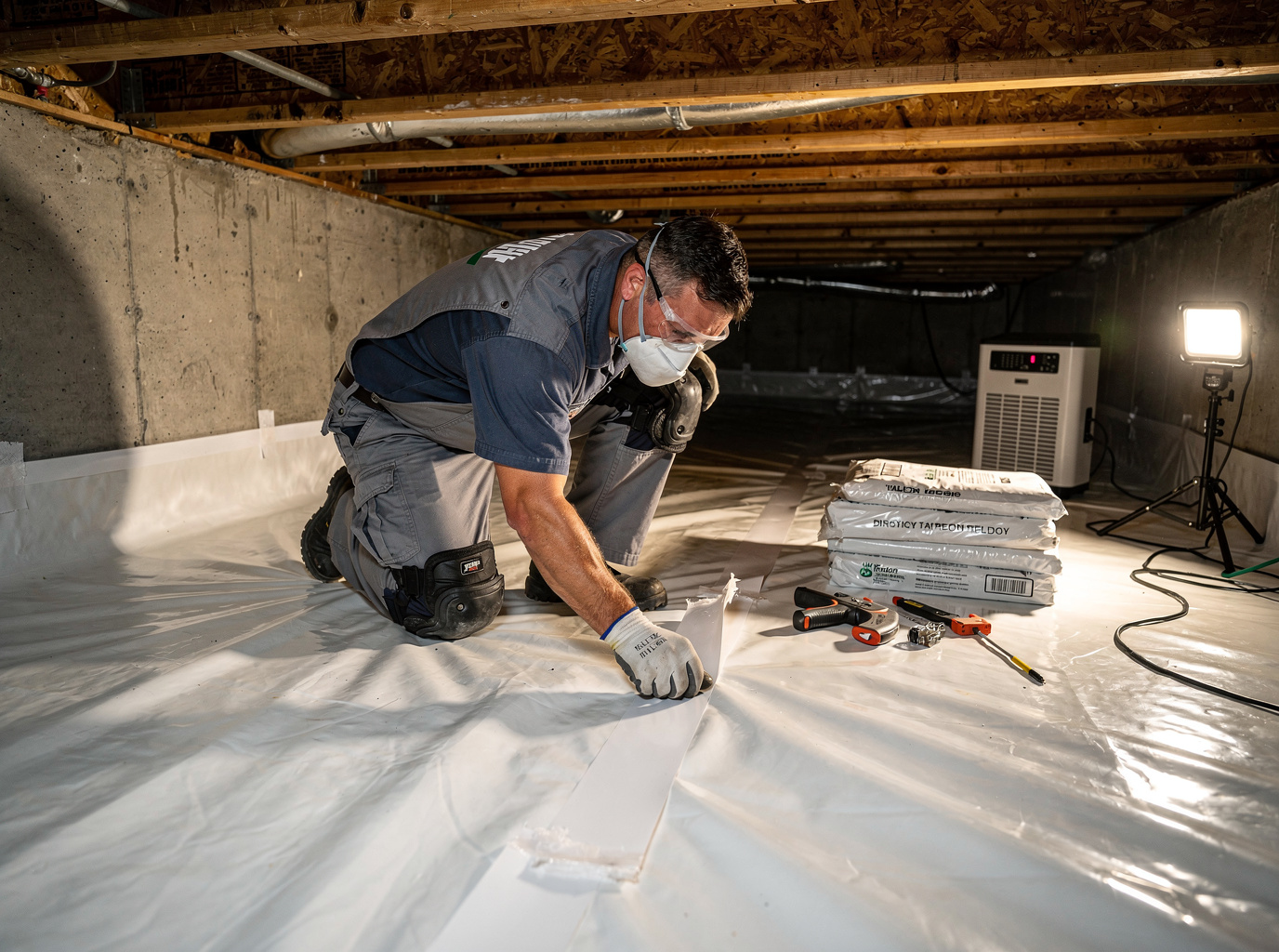
Warren homes in neighborhoods like Downtown Warren and Lordstown often sit on older stone or block foundations that allow humid air to rise into living spaces during the county's cold winters. Encapsulation starts with a heavy-duty 20-mil vapor barrier sealed to the foundation walls and piers, then adds closed-cell foam on the rim joists to stop condensation that forms when warm summer air meets chilled concrete. Without this full seal, vents left open in winter pull moist air from nearby Youngstown and Niles across the dirt floor, feeding mold on floor joists.
In Northwest Warren and Howland, the clay-heavy soil holds water longer after spring thaws, so we route perimeter drains to a sump before laying the liner. This keeps the encapsulated space at 45-55 percent humidity even when Trumbull County temperatures swing from below freezing to the mid-80s. We also address low-clearance crawlspaces common in 1950s-1970s homes by using reinforced liner sections that won't tear during annual inspections.
Homeowners sometimes try partial barriers that leave the rim and piers exposed; those gaps let warm, humid air from Girard infiltrate and condense on cold pipes all winter. Full encapsulation includes taping every seam and installing a dedicated dehumidifier sized for the square footage, which runs efficiently because the space is now isolated from outside air changes.
Technician insight
In Warren, the thing that catches most people out with Crawlspace Encapsulation is the stone foundations common in Downtown Warren and Lordstown homes; those irregular surfaces need extra sealing time or moisture still migrates when winter temperatures drop and the ground stays saturated.
Crawlspace Encapsulation in a Howland Split-Level
Moisture was migrating through the dirt floor and stone piers into the first floor during cold snaps. We found open vents pulling humid air from the surrounding Trumbull County terrain. We installed a full sealed liner, added rim insulation, and tied a sump to an existing drain line. The homeowner reported dry joists and stable humidity the following winter.
Crawlspace Encapsulation Services We Offer
✓Vapor Barrier Installation
Heavy 20-mil reinforced liner sealed to walls and piers stops ground moisture from entering Warren crawlspaces year-round.
✓Crawlspace Insulation Upgrades
Closed-cell spray foam on rim joists and walls prevents condensation during Trumbull County's winter temperature swings.
✓Integrated Dehumidification Systems
Dedicated units sized for the sealed space maintain 45-55 percent humidity in Howland and Lordstown homes.
✓Sump Pump and Drainage Enhancements
Perimeter drains and battery-backed pumps handle clay soil water that lingers after winter thaws in Northwest Warren.
✓Mold Prevention Treatments
Antimicrobial coatings applied before liner installation protect floor joists in older Downtown Warren crawlspaces.
✓Access Door Sealing
Insulated, gasketed doors replace loose crawlspace entries common on homes near the Trumbull County Courthouse.
How it works
- 1
Site Assessment
We measure clearance, note foundation type, and check for standing water in crawlspaces across Warren neighborhoods.
- 2
Moisture Control Prep
Any existing water is directed to a sump, then the dirt floor is leveled and covered with a base layer.
- 3
Barrier and Insulation Application
The 20-mil liner is sealed to walls and piers, followed by rim-joist foam to block cold-weather condensation.
- 4
Final Testing and Handover
We run the dehumidifier, verify humidity levels, and show homeowners how to inspect the sealed space seasonally.
Pricing
Pricing varies by crawlspace size, access difficulty, and any drainage work required in Trumbull County clay soils; contact for an on-site quote during business hours.